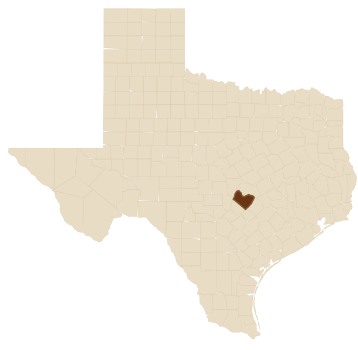
In 1839 the Republic of Texas was three years old and wanted a permanent capital.2 A commission sent by the Texas Congress chose a hamlet called Waterloo on the Colorado River at the western edge of settlement, and it bought 7,735 acres of land there.2 Edwin Waller and two surveyors, L. J. Pilie and Charles Schoolfield, chose 640 acres of that land between two creeks and laid out a city on paper.2 Travis County was created around that city.
Before the capital
Archeological evidence suggests that hunting and gathering peoples lived here as early as 10,000 years ago. The Tonkawas and Lipan Apaches were well established by the fourteenth century, and Comanches and Kiowas arrived by the eighteenth.1 The first European known to have crossed the region was Domingo Terán de los Ríos in 1691.1 In 1730 the Spanish moved three missions out of East Texas and relocated them near Barton Springs.1
Under Mexico the area fell within Stephen F. Austin’s “Little Colony” of 1827, run from Mina, now Bastrop.1 Josiah and Mathias Wilbarger, Reuben Hornsby, Jacob M. Harrell and John F. Webber were among the settlers in the early 1830s.1 Josiah Wilbarger had taught school and done surveying before settling on the Colorado. In August 1833 he was with a surveying party attacked near Pecan Springs, four miles east of the future site of Austin.4 He was scalped but still alive when Reuben Hornsby found him the next day. He never fully recovered, but he lived about eleven more years.4
In June 1835 Thomas Jefferson Chambers surveyed part of an eight-league grant that covered the future sites of Austin and the Capitol.1 Sometime before 1837 William Barton settled near the springs that would bear his name.1 In 1838 Waterloo consisted of four families.1
Waller’s grid
Mirabeau B. Lamar, a champion of westward expansion, had visited the area in 1838, and as president he sent the site-selection commission to see it.2 The commissioners were impressed by its beauty, healthfulness, resources and central location. Many Texans, Sam Houston among them, objected that it was too remote and too exposed to raids.2
Lamar chose Edwin Waller to plan and build the new capital. Waller was a signer of the Texas Declaration of Independence. He was bonded on April 12, 1839, and began his work under the protection of armed citizens.3 Pilie and Schoolfield, working under his direction, picked a 640-acre site fronting the Colorado between Waller Creek on the east and Shoal Creek on the west.2 Their plan was a grid fourteen blocks square, divided by Congress Avenue and running north from the river to “Capitol Square.”2
The first lots were auctioned on August 1, 1839.2 Waller put up temporary buildings to have the town ready in time, including a one-story frame capitol on a hill at what is now Colorado and Eighth streets.2 In October Lamar arrived, government offices opened, the Presbyterians organized the first church, and the Austin City Gazette began publication.2 Congress convened in November, Austin incorporated on December 27, and on January 13, 1840, Waller was elected its first mayor.2,3
Travis County
In January 1840 the Congress established Travis County, named for William Barret Travis, the Texas commander at the Alamo, and made Austin its seat.1,8 Its first boundaries took in roughly 40,000 square miles. Comal, Gillespie, Hays, Burnet, Brown, Lampasas and Coleman were among the counties later carved from it.1 At the first election, in February 1840, the population was reported as 856.1
The Archives War
In March 1842 a Mexican army took San Antonio, and President Houston moved the government to Houston and then to Washington-on-the-Brazos.2,5 Austin’s citizens saw removal of the archives as the choice of a new capital and warned that any attempt to move the state papers would be met with armed resistance.2,5 At the end of December 1842 Houston sent a company of rangers to take them.5 The rangers loaded the archives into wagons and drove off, but not before Angelina Eberly fired a cannon at them.5 On January 1, 1843, the vigilance committee overtook the wagons at Kenney’s Fort on Brushy Creek, and after a few shots the rangers gave up the papers to avoid bloodshed.5
Austin’s population fell below 200 between 1842 and 1845, and its buildings decayed.2 In the summer of 1845 a convention meeting in Austin approved annexation to the United States, and on February 19, 1846, Austin officially became the capital of the state of Texas.2
A railroad, a university and a granite Capitol
Austin won the 1850 election for the capital and began building in earnest: a capitol at the head of Congress Avenue in 1853 and the Governor’s Mansion in 1856.2 By 1860 the county had 8,080 people, 3,136 of them enslaved.1 In February 1861 Austin and Travis County voted against secession, 704 to 450.2 After the war newly freed families founded the communities of Masontown, Wheatville, Pleasant Hill and Clarksville.2
On December 25, 1871, the Houston and Texas Central brought Austin its first railroad. As the westernmost rail terminus in Texas, the town became the trading center for a vast area.2 In 1872 Austin won the statewide election to settle the capital once and for all, and in 1881 it won the election for the new University of Texas, which began classes two years later.2
The Constitution of 1876 set aside three million acres of Panhandle land to pay for a new Capitol.6 Governor John Ireland and the Capitol Board wanted Texas stone, specifically red granite from Granite Mountain in Burnet County.6 The building was dedicated during a week-long celebration in May 1888.6 In 1895 thirty-one new 150-foot “moonlight towers” began lighting Austin at night.2
The river tamed
The city built a sixty-foot dam on the Colorado by 1893.2 Decades later the Lower Colorado River Authority began Marshall Ford Dam in February 1937, and after delays it was completed in 1942. Renamed Mansfield Dam in 1941, it formed Lake Travis.7 A fire badly damaged the Capitol’s east wing in February 1983, and after a long restoration it was rededicated on April 21, 1995.6 It still stands at the head of Congress Avenue, at the north end of the grid the surveyors drew in 1839.2,6
Through the years
- 1730Three East Texas missions are moved to the Colorado near Barton Springs.1
- August 1833Josiah Wilbarger’s surveying party is attacked near Pecan Springs.4
- 1839A commission buys 7,735 acres around Waterloo for the capital.2
- August 1, 1839The first lots in Austin are auctioned.2
- January 1840Congress creates Travis County with Austin as its seat.1,9
- December 1842The Archives War.2,5
- February 19, 1846Austin becomes the capital of the state of Texas.2
- December 25, 1871The Houston and Texas Central brings Austin’s first railroad.2
- 1872Austin wins the statewide election for the permanent capital.2
- May 1888The granite Capitol is dedicated.6
- 1942Marshall Ford Dam, later Mansfield Dam, is completed, forming Lake Travis.7
Sources
- 1. Vivian Elizabeth Smyrl, “Travis County,” Handbook of Texas Online, Texas State Historical Association. www.tshaonline.org
- 2. David C. Humphrey, “Austin, TX (Travis County),” Handbook of Texas Online, Texas State Historical Association. www.tshaonline.org
- 3. Charles Spurlin, “Waller, Edwin Leonard,” Handbook of Texas Online, Texas State Historical Association. www.tshaonline.org
- 4. Roy A. Clifford, “Wilbarger, Josiah Pugh,” Handbook of Texas Online, Texas State Historical Association. www.tshaonline.org
- 5. Claudia Hazlewood, “Archives War,” Handbook of Texas Online, Texas State Historical Association. www.tshaonline.org
- 6. William Elton Green, “Capitol,” Handbook of Texas Online, Texas State Historical Association. www.tshaonline.org
- 7. Seth D. Breeding, “Lake Travis,” Handbook of Texas Online, Texas State Historical Association. www.tshaonline.org
- 8. Archie P. McDonald, “Travis, William Barret,” Handbook of Texas Online, Texas State Historical Association. www.tshaonline.org
- 9. Newberry Library, Atlas of Historical County Boundaries: Texas individual county chronologies. publications.newberry.org
Explore further
Historical information only. Garrett Surveying, LLC is a land surveying firm, not a law firm, and nothing here is legal advice.