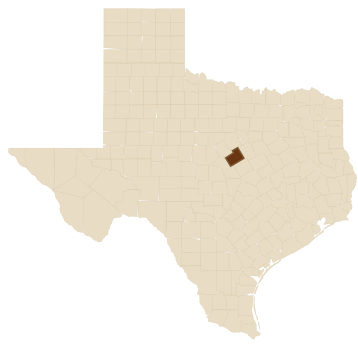
Hamilton County is rolling prairie broken by flat-topped buttes that rise suddenly between its streams, with limestone cliffs along the deep valleys of the Leon, the Lampasas and the Bosque.1 Pioneers built along the wooded creeks and left the divides between them as open range, and the coves and creek bottoms where they settled became the towns of the county.1
Two counties named Hamilton
The name was used twice. On February 2, 1842, the Republic of Texas created a judicial county called Hamilton out of Houston and Montgomery counties, in a different part of Texas altogether. It disappeared within months, when the Republic’s Supreme Court ruled judicial counties unconstitutional.3 The present county came later and carries the name of James Hamilton, a governor of South Carolina who put some $216,000 in gold behind the Texas struggle for independence.1
A store, a sawmill and a petition
Indian burial mounds have been found on Cowhouse Creek near Pottsville, and Wacos, Tawakonis, Tonkawas and Comanches all knew this country.1 The first permanent Anglo-American settlers were probably Robert Carter and his family, who came in 1854. Within a year James Rice and Henry Standefer had opened a store that grew into the town of Hamilton, and Asa Langford had built a sawmill, a blacksmith shop, a store and a gristmill at Langford’s Cove, today’s Evant.1
In 1856 the settlers petitioned for a county of their own.1 The Newberry Library’s boundary atlas dates the act creating Hamilton County, from parts of Bosque and Lampasas and unorganized land, to January 22, 1858, and its organization to August 2 of that year.3 A five-man commission chose the town of Hamilton as the county seat.1 The 1879 statute book still described the county by the lines of its neighbors, Bosque, Erath, Brown and Coryell, rather than by any natural feature.6
The frontier on the Leon
Growth was slow at first. The 1860 census found 489 people, and the county’s first post office opened that year at Hico.1 Only 290 of the county’s 1,800 acres of farmland were improved, and although most residents raised stock, the census counted just 36 horses, 47 sheep, 160 milk cows and 496 other cattle.1 During the Civil War local men formed militia companies to defend the frontier. In 1867 Indians attacked a school on the Leon River and killed the teacher, Ann Whitney, and a neighboring farmer; several children were wounded or captured. Raids went on until 1875, though by 1870 the danger had eased and settlers were arriving in greater numbers.1
The 1870s brought them by the thousands. Ranchers drove cattle to market on a branch of the Chisholm Trail between Hico and Carlton, the Hamilton Herald began publishing in 1876, and a stone jail replaced the wooden one. By 1880 the county had 6,365 people and almost 7,000 acres of cotton.1
A courthouse that kept burning
The county’s courthouses had bad luck. The courthouse nomination records a $12,000 building in the center of the public square that was completed in less than a year and then burned in 1886. A fireproof record vault, with double brick walls and a brick barrel vault overhead, came through the fire.5 Its replacement was built in nine months with a fireproof interior, and the county made the final payment in February 1887. In 1931 and 1932 it was enlarged and remodeled on plans by E. M. Miles, with new wings that changed its character.5
Hico moves to the railroad
Hico began in 1856 on Honey Creek, where families named Anderson, Fuller, Barbee, Steen and Malone settled.4 Its founder, Dr. John R. Alford, named it for his hometown in Kentucky and became its first postmaster in 1860.2,4 When the Texas Central Railroad was built across the northeastern corner of the county in 1880, the townspeople picked up and moved about two miles to the line.1,2 The new Hico was incorporated in 1883 and became the county’s shipping center. Fires swept both sides of Pecan Street in 1890, and the town rebuilt in stone.2 Today a memorial on Honey Creek, built with rocks from the ruins of the old mill, marks where the first town stood.4
Cotton and the long decline
Cotton took over in the 1880s and 1890s, despite drought from 1881 to 1887, fence-cutting fights and quarrels between cattlemen and sheep raisers. Many newcomers bought farm tracts that speculators carved out of former rangeland, and others bought public school lands. Hard times bred politics too: the Populist Journal-News was published in Hamilton, and the People’s party won some county offices between 1894 and 1900.1 By 1890 it was the county’s most important crop, and it peaked in 1910, when more than 79,000 acres were planted and the population reached 15,315.1 In 1907 two new railroads connected Hamilton with Stephenville and Comanche.1
Then the long slide began. Cotton fell in the 1920s, the Depression deepened the losses, and both newer railroads ended service to Hamilton by 1940, though none of the county’s banks failed.1 Farm consolidation and the drought of 1948 to 1954 pushed the population down to 7,198 by 1970. Dairies, cattle and pecans carried the county into later years, and Hico’s Old Settlers’ Reunion, begun in 1882, became an August tradition.1,2
Through the years
- February 2, 1842The Republic creates a judicial county named Hamilton, far to the east of the present county.3
- 1854Robert Carter and his family become the first permanent settlers.1
- 1856Settlers petition for a new county; Hico begins on Honey Creek.1,4
- January 22, 1858The legislature creates Hamilton County.3
- 1860The county’s first post office opens at Hico.1,4
- 1867Indians attack a school on the Leon River and kill the teacher, Ann Whitney.1
- 1880The Texas Central Railroad crosses the county, and Hico moves to the tracks.1,2
- 1886The courthouse burns; its record vault survives.5
- February 1887The county makes its final payment on a new, fireproof courthouse.5
- March 15, 1887Part of the county goes to the new Mills County.3
- 1907Two railroads connect Hamilton with Stephenville and Comanche.1
- 1931–32The courthouse is enlarged and remodeled.5
Sources
- 1. John Leffler, “Hamilton County,” Handbook of Texas Online, Texas State Historical Association. www.tshaonline.org
- 2. William R. Hunt, “Hico, TX,” Handbook of Texas Online, Texas State Historical Association. www.tshaonline.org
- 3. Newberry Library, Atlas of Historical County Boundaries: Texas individual county chronologies. publications.newberry.org
- 4. Texas Historical Commission, Atlas marker no. 5193002467, “Old Hico”. atlas.thc.texas.gov
- 5. National Register of Historic Places nomination, Hamilton County Courthouse (No. 80004125). atlas.thc.texas.gov
- 6. Texas State Law Library, Revised Civil Statutes of the State of Texas (1879), art. 798, Hamilton County boundary. sll.texas.gov
Explore further
Historical information only. Garrett Surveying, LLC is a land surveying firm, not a law firm, and nothing here is legal advice.