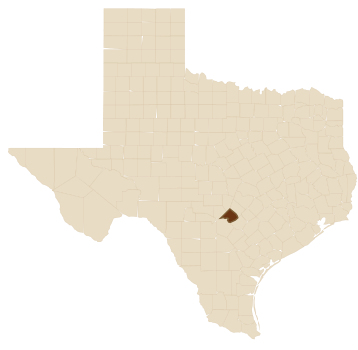
On the northwestern edge of New Braunfels, water pushes up through fissures in the limestone along the Comal Springs fault. These are the largest natural springs in Texas, and they feed Landa Lake and the short Comal River.5 For centuries people camped beside them. Then, on Good Friday in 1845, a wagon train of German immigrants arrived, led by an engineer who would survey their town.3,4 What they built became, within five years, one of the largest towns in Texas.2
Las Fontanas
The Spanish knew the springs well but had little interest in settling here.1 When Damián Massanet visited in 1691, he found a large group of Indians at the springs.5 After Domingo Terán de los Ríos’s expedition that same year, the Old San Antonio Road crossed the Guadalupe near the future site of New Braunfels, and later travelers such as the Marqués de Aguayo and Louis Juchereau de St. Denis passed through.1 From 1756 to 1758 the springs were the site of a mission, Nuestra Señora de Guadalupe, but rather than fortify it against expected Comanche raids, Spanish authorities closed it.1,5
During the eighteenth century the springs and river, once called Las Fontanas and the Little Guadalupe, took the name Comal, Spanish for “flat dish.” The name may have been suggested by the small islands in the river or by the shallow basin it runs through.1 In 1825 a Mexican land grant gave title to the land around the springs to Juan Martín Veramendi.1,4 On the eve of German settlement, the region was home mainly to Tonkawa and Waco Indians. A village of some 500 Tonkawas on the Guadalupe above the site of New Braunfels at first welcomed German visitors.1
The prince and the society
The settlement was the project of the Adelsverein, a German society organized in 1842 and reorganized in 1844 to plant German colonies in Texas.1,4 Its first commissioner-general was Prince Carl of Solms-Braunfels, a cavalry officer whose family connections included Queen Victoria and Prince Albert. He reached Galveston on July 1, 1844, provisioned with two cannons, table linens and twelve place settings.4 Looking ahead to the migration, he wrote:
The eyes of all Germany, no, the eyes of all Europe are fixed on us and our undertaking …
The prince bought land on Matagorda Bay for a landing place, Carlshafen, later Indianola.4 Near Victoria he left the immigrants and rode ahead to San Antonio to buy a fertile, well-watered tract on the Guadalupe and Comal rivers from Juan Martín Veramendi and Raphael C. Garza.4 In all, the society secured title to 1,265 acres of the Veramendi grant, including the springs and the river.1
Zink’s town
The man who brought the settlers in was Nicolaus Zink, a civil engineer and former Bavarian army officer. From December 1844 to March 1845 he led about half of the immigrants overland from Indianola by way of Victoria, McCoy’s Creek and Seguin.3 On March 21, 1845, the wagons and pushcarts under his command reached the east bank of Comal Creek, a site chosen by the prince.2,3 On a rise where Saints Peter and Paul Catholic Church was later built, Zink put up a palisade around the first tent camp. It was called the Zinkenburg, and the settlers lived inside it until they could build houses.3
Zink then made the original survey of the townsite and the farmland around it.3 Within weeks Prince Solms laid the cornerstone of the Sophienburg, a more permanent fort and headquarters, and turned leadership of the colony over to John O. Meusebach.2 By summer there were 300 to 400 settlers, and the town took the name of the prince’s family seat on the Lahn River in Germany, Braunfels.2 Zink Street was named for him.3 His original plan survives: the 2021 National Register registration for Main Plaza reproduces it as Figure 1, and the boundary he drew in 1845 is still reflected in the downtown street grid.8 Zink himself soon moved on. He built the first house at what became Sisterdale, ran a gristmill south of Fredericksburg, and died in 1887 near his home at Welfare.3
The plaza at the center of Zink’s plan was meant to stay open. The same nomination records that in 1849 the City of New Braunfels donated a site near Comal Springs to the county for a courthouse, with the provision that the county could not build at the center of Main Plaza, even if it later sold the donated site and built elsewhere. The county eventually built its courthouse beside the plaza rather than in it.8
Fourth-largest town in Texas
In March 1846 the legislature formed Comal County from Bexar County’s Eighth Precinct and made New Braunfels its seat, and the first county elections were held on July 13.1 The springs gave reliable water power, and the town sat on the road between Austin and San Antonio.2 Within a decade New Braunfels was making wagons, farm implements, leather goods, furniture and clothing for the settlers moving into the hills, and in 1850 it was reported to be the fourth-largest town in Texas.2 Its German newspaper, the Neu Braunfelser Zeitung, began in 1852 and was published in German until 1957.2
The town took schooling seriously. In 1858 citizens voted unanimously to tax themselves for a public school, eighteen years before the Constitution of 1876 provided for such taxes across Texas.2 They also founded the Germania Singing Society, a shooting club and one of the early Turnvereins, the German athletic clubs.2 From 1846 into the 1880s, a number of Hispanic people and Lipan Indians moved into New Braunfels each spring during the sheep-shearing season.2 The county’s final boundaries were set in 1858, when part of western Comal County went to new Blanco and Kendall counties.1
A German county and the Confederacy
Comal County stood apart from the other German counties of the region in the strength of its 1861 vote for secession, and it sent three all-German volunteer companies to the Confederacy.1 Slavery was not the reason. A survey of 130 German farms in Comal and two other counties in 1850 found no enslaved laborers, and family labor remained the rule. The Handbook suggests that residents supported the Southern cause out of belief in states’ rights.1 There is no record in Comal County of the violence between Unionists and Confederates that broke out in German counties farther northwest.1
Mills, textiles and a town called Gruene
The water kept working. The springs powered grist and saw mills in the 1860s and a hydroelectric plant for New Braunfels from 1890 to 1950.5 During the Civil War John F. Torrey brought in machinery and looms to make cotton textiles, and George Weber established the first cottonseed press in the state.1 In 1867 a company was organized in New Braunfels to make woolen goods.1
Upriver, the Gruene family bought 6,000 acres north of the Guadalupe in 1872. In 1878 Henry D. Gruene built a mercantile store at the river crossing for the families who sharecropped the family land, and he soon added a cotton gin and a dance hall.6 The boll weevil and the Depression emptied the town, and by 1950 it was a ghost town.6 Restoration began in the 1970s, and today the whole town is on the National Register of Historic Places. Its dance hall is touted as the oldest operating in the state.6
Parks, a lake and the springs today
When electricity replaced water and steam power, riverfront land inside New Braunfels became free for public use, and by 1936 the city had bought Landa and Cypress Bend parks.2 Natural Bridge Caverns and the Wurstfest opened in the early 1960s, and Canyon Lake began holding back the Guadalupe in 1964.1,2 The springs that drew Massanet’s Indians, the Spanish friars and Zink’s wagon train still flow into Landa Lake. Their flow, and the plants and animals that depend on it, are threatened by the falling level of the Edwards Aquifer.3,5
Through the years
- 1691Damián Massanet finds a large group of Indians camped at Comal Springs.5
- 1756–58The Spanish mission of Nuestra Señora de Guadalupe operates at the springs.1,5
- 1825A Mexican land grant gives Juan Martín Veramendi title to the land around the springs.1,4
- March 21, 1845Nicolaus Zink’s wagon train arrives on Good Friday, and New Braunfels is founded.2,4
- March 1846The legislature creates Comal County with New Braunfels as its seat.1,7
- 1850New Braunfels is reported to be the fourth-largest town in Texas.2
- 1852The Neu Braunfelser Zeitung publishes its first edition.2
- 1858New Braunfels voters agree to tax themselves for public schools.1,2
- 1878Henry D. Gruene opens his mercantile store at the Guadalupe crossing.6
- 1898A permanent courthouse opens beside the town square.2
- 1964Canyon Lake begins to fill on the Guadalupe.1
Sources
- 1. Daniel P. Greene, “Comal County,” Handbook of Texas Online, Texas State Historical Association. www.tshaonline.org
- 2. Daniel P. Greene, “New Braunfels, TX,” Handbook of Texas Online, Texas State Historical Association. www.tshaonline.org
- 3. Crystal Sasse Ragsdale, “Zink, Nicolaus,” Handbook of Texas Online, Texas State Historical Association. www.tshaonline.org
- 4. Glen E. Lich and Günter Moltmann, “Solms-Braunfels, Prince Carl Of,” Handbook of Texas Online, Texas State Historical Association. www.tshaonline.org
- 5. Gunnar Brune, “Comal Springs,” Handbook of Texas Online, Texas State Historical Association. www.tshaonline.org
- 6. Daniel P. Greene, “Gruene, TX,” Handbook of Texas Online, Texas State Historical Association. www.tshaonline.org
- 7. Newberry Library, Atlas of Historical County Boundaries: Texas individual county chronologies. publications.newberry.org
- 8. National Register of Historic Places registration, Main Plaza, New Braunfels (No. 100007074, listed October 12, 2021), Figure 1, Zink plan. atlas.thc.texas.gov
Explore further
Historical information only. Garrett Surveying, LLC is a land surveying firm, not a law firm, and nothing here is legal advice.