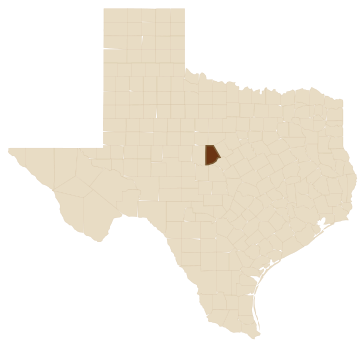
Brown County sits near the geographic center of Texas, a rolling country of loam and sand cut by Pecan Bayou and bounded on the south by the Colorado River.1 It was surveyed before it was settled and settled long before it was safe. Its county seat began on one bank of the bayou and ended up on the other, on ground given by a surveyor who had walked these hills when they were still empty of farms.1,3
Riders on the Pecan Bayou
In the nineteenth century this was the country of the Penateka Comanches, sometimes called the Honey-Eaters, the southernmost Comanche band.1 The first Europeans in the area were Spanish soldiers under Capt. Nicolás Flores, who rode through in 1723 chasing Apaches to recover stolen horses and captives. Another Spanish expedition followed in 1759.1
The county’s namesake arrived in the same way, in pursuit. In 1828 Capt. Henry Stevenson Brown led a party of Anglo-Americans into the region to recover livestock taken by Comanches.1 Brown was a Kentuckian who had fought in the War of 1812 and traded by flatboat between Missouri and New Orleans before landing at the mouth of the Brazos in 1824. He commanded a company at the battle of Velasco in 1832, served as a delegate to the Convention of 1832, and died in 1834, more than twenty years before the county was named for him.4
The surveyor-judge
Land surveys were made in the area in 1838.1 The man who would matter most came later. Greenleaf Fisk was born in Albany, New York, in 1807, trained for the Presbyterian ministry, and then gave it up and came to Texas in 1834. He fought at San Jacinto, served in the Congress of the Republic from Bastrop, and helped found Liberty Hill and Georgetown in Williamson County.3 In 1846 he surveyed parts of what would become Brown County, and that December he was granted title to 1,280 acres there, the Marcus Hulen survey, for his service to the republic.3
Settlement began in earnest in 1856, when Welcome W. Chandler, John H. Fowler and others settled in the valleys of Pecan Bayou and Jim Ned Creek.1 That year the legislature created Brown County on the western frontier.6 It was organized in 1858 with Brownwood as its seat, and the town got the county’s first post office, with Wiley B. Brown as postmaster.1 The 1860 census found only 244 people in the county, none of them slaveholders, and just ninety-one acres of improved land.1
Fisk moved his family to Brown County in 1860. Between 1862 and the mid-1870s he served as teacher, chief justice, county judge, justice of the peace, county surveyor, district clerk, county clerk and county treasurer. People called him Judge Fisk.3 He taught the county’s first school in 1860.1
A town that crossed the bayou
Brownwood began on the east side of Pecan Bayou. In the late 1860s a dispute over the land title and an inadequate water supply persuaded the residents to move.2 Fisk donated sixty acres on the west side for a new townsite, near his own home, and another hundred acres for county use.3 The original deed burned with the courthouse in 1880, so the exact date of the move is uncertain. It happened sometime between 1867 and 1879, and in a replacement deed filed in 1880 Fisk wrote that he had made the gift “about ten years ago.”3 He wanted enough families in town to fill a school, so he sold T. D. Harriss 800 acres beside the townsite on good terms, on the condition that Harriss move his large family there.3
The new town was slow to grow. As late as 1872 it had two stores, a log courthouse and about five houses.2 Fisk built a two-story stone home and a stone gristmill, doing the masonry himself, and the mill still stands in Brownwood as a private residence.3 When he died in 1888 the whole town closed for his funeral. He is buried in Greenleaf Cemetery, on land he had given.3 Local historians call him the father of Brownwood.3 The old townsite on the east bank did not stay empty. It is now the city of Early.2
Brown County also gave up land. On March 15, 1887, the legislature created Mills County from parts of Brown, Comanche, Hamilton and Lampasas counties, and dividing Brown County’s debts with the new county led to a lawsuit that reached the Texas Supreme Court in 1892.6,7 The Mills County history in this series tells that county’s story.
Stage robbers, cowboys and fence cutters
Twenty years of raids and outlaws kept Brown County unsettled until the late 1870s. Comanches came in from the north through Mercer’s Gap or from the west along Pecan Bayou, and in 1875 the Fort Worth–Brownwood stage was robbed five times in two months.1 Much of the trouble was blamed on John Wesley Hardin’s gang, and in 1874 Brown County citizens joined in lynching suspected gang members at Comanche.1
Cattle ruled the county’s economy for most of the century. Herds grew from 2,070 head in 1860 to about 40,000 in 1880.1 Brownwood lay on a feeder line of the Western Trail, and its stores and saloons served the cowboys who drove herds through town.2 When farmers began fencing the open range, ranchers fought back. The fence-cutting strife lasted several years until 1886, when the Texas Rangers killed two fence cutters.1 Farms multiplied anyway, from twenty-two in 1870 to 1,396 in 1890.1
Cotton, colleges and a lake
By the mid-1890s two railroads served Brownwood. Farmers from counties without rail service came there to market their crops, and by 1920 the city was the largest cotton-buying center west of Fort Worth.1,2 Presbyterians founded Daniel Baker College and Baptists founded Howard Payne College, both by 1890. The two schools combined in 1953, and the school is now Howard Payne University.1,2 Oil came too. Jack Pippen brought in the first commercial production at Brownwood in 1917, and a boom in 1926 brought some 600 wells.1
The dream of a dam below the junction of Pecan Bayou and Jim Ned Creek began during the drought of 1894 and 1895. In 1928 voters of the Brownwood Water District approved $2.5 million in bonds, and the dam was finished in 1932.1 Engineers had predicted that it would take several years of normal rainfall to fill the lake. Instead, an almost unprecedented storm in July 1932 filled it in six hours.1
Camp Bowie and the writers
In the fall of 1940 the army built Camp Bowie south and southwest of Brownwood. It became the largest military training center in Texas.2 By December 1940 its 13,500 construction workers outnumbered the town’s entire 1940 population. Residents turned a skating rink into a dormitory and let people sleep in a movie theater after the last show.2 The camp closed in 1946.2 German prisoners of war were also held there.1
Brown County also gave the country two writers. Katherine Anne Porter was born on a farm at Indian Creek.1 Robert E. Howard finished high school in Brownwood in 1923, and while earning a business certificate at Howard Payne he sold his first story to the pulp magazine Weird Tales.5 His most popular character was Conan the Barbarian.5
Two towns on one bayou
Today Brownwood and Early face each other across Pecan Bayou, the old townsite and the new.2 The surveyor who first measured this country in 1846 lies in the cemetery he gave the town he moved.3 In 2014 a Texas Historical Commission cemetery marker was dedicated for Judge Fisk.3
Through the years
- 1723Spanish soldiers under Capt. Nicolás Flores pursue Apaches into the area.1
- 1828Henry Stevenson Brown leads a party in to recover livestock taken by Comanches.1
- 1846Greenleaf Fisk surveys parts of the future county.3
- August 27, 1856The legislature creates Brown County on the western frontier.6
- 1858The county is organized, with Brownwood as its seat.1
- 1860Judge Fisk teaches the county’s first school.1
- 1867–79Brownwood moves to the west bank of Pecan Bayou, onto land given by Fisk.2,3
- 1886Texas Rangers kill two fence cutters, ending years of fence-cutting strife.1
- 1917Jack Pippen brings in the first commercial oil production at Brownwood.1
- July 1932A storm fills the new Lake Brownwood in six hours.1
- 1940–46Camp Bowie trains troops south and southwest of Brownwood.2
Sources
- 1. John Leffler, “Brown County,” Handbook of Texas Online, Texas State Historical Association. www.tshaonline.org
- 2. Mark Odintz, “Brownwood, TX,” Handbook of Texas Online, Texas State Historical Association. www.tshaonline.org
- 3. Charlotte Laughlin, “Fisk, Greenleaf,” Handbook of Texas Online, Texas State Historical Association. www.tshaonline.org
- 4. John Q. Anderson, “Brown, Henry Stevenson,” Handbook of Texas Online, Texas State Historical Association. www.tshaonline.org
- 5. Charlotte Laughlin, “Howard, Robert Ervin,” Handbook of Texas Online, Texas State Historical Association. www.tshaonline.org
- 6. Newberry Library, Atlas of Historical County Boundaries: Texas individual county chronologies. publications.newberry.org
- 7. Mills County v. Brown County, 85 Tex. 391 (1892), Supreme Court of Texas. law.justia.com
Explore further
Historical information only. Garrett Surveying, LLC is a land surveying firm, not a law firm, and nothing here is legal advice.